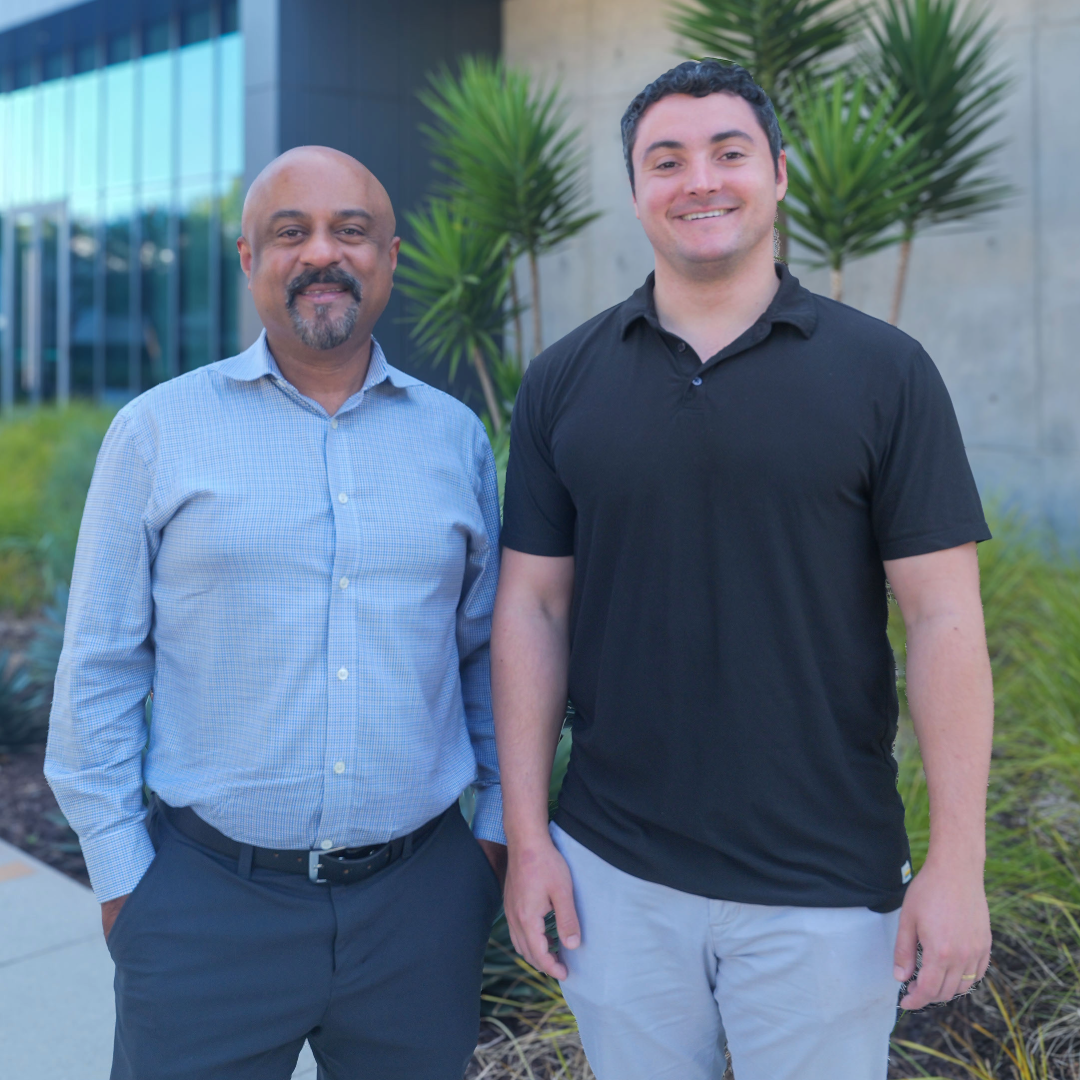
Most people wouldn’t describe a 4 a.m. alarm and a cross-country flight as a normal Wednesday. Max Z. does, and he says it with something close to gratitude.
Every month, Max rises before dawn at his home in Texas, drives to the Dallas airport, and boards his first flight of the day. He rents a car, drives south to the City of Torrance, and walks into the office of Santosh Kesari, MD, PhD, rare cancers specialist and investigator in the Advanced Therapeutics and Biomedical Technologies Innovation Hub at The Lundquist Institute for Biomedical Innovation.
A blood draw. An electrocardiogram (EKG). A carefully monitored dose of an experimental medication. Another EKG and, eventually, a return to the airport for a flight back home. This is what hope looks like for someone living with a rare tumor condition with almost no promising treatment option.
A Diagnosis No One Saw Coming
For nearly a year, Max experienced a persistent itchy, tingling sensation in his ear, followed by worsening tinnitus. Two ear, nose and throat specialists dismissed his concerns. A third ordered a computed tomography (CT) scan, and a radiologist noticed something troubling: Max’s left auditory canal appeared wider than it should.
An MRI followed. Before Max could leave the parking lot of the imaging center, he was told he needed surgery immediately. His surgeon tried to preserve his hearing but could not safely remove the entire tumor, so Max lost most of the hearing in his left ear. Severe tinnitus remained.
The diagnosis changed more than Max’s hearing. It gave him a new mission: to help identify a cure.
A Search That Led Him Around the World
Since then, Max has pursued possibilities across the globe, exploring combination immunotherapies, shelved drugs with promising new targets, and single-patient investigational pathways. Many treatments have been grueling, but Max has persisted because the alternatives are so limited: another surgery is too risky, and the tumor’s size and location make radiation unsuitable.
In 2019, he was referred to Dr. Kesari to explore nonsurgical approaches. Max was willing to try anything.
What followed was an unlikely collaboration that might never have happened without the right people at the right institution. NF2 Biosolutions, a nonprofit advancing research on this condition, identified a South Korean company developing an experimental drug specifically for Max’s tumor type. The company had access to a government grant program, but it required a U.S. partner to move forward.
Dr. Kesari and The Lundquist Institute became that partner, and a single-patient clinical trial took shape. Without that connection, the opportunity could easily have been lost.
Relentless, Creative, and No Stone Unturned
Unlike several of Max’s earlier treatments, the experimental drug has so far been remarkably well-tolerated. A highly targeted therapy with fewer side effects could be meaningful not only for Max, but for the broader community of patients with NF2-related tumors who urgently need nonsurgical options, and for whom time is not on their side.
Three-month MRIs will predict the next chapter.
For Max, Dr. Kesari’s value goes far beyond medical expertise. “I feel like I’ve found a partner willing to engage with complexity,” he said, describing Dr. Kesari’s openness to unconventional possibilities and his careful judgment about when to take risks. “Dr. Kesari is relentless, creative, and will leave no stone unturned.”
That trust has been built across years of early-morning flights, careful monitoring, and a shared conviction that progress sometimes requires looking beyond what’s already tried.
Why Donors Make This Possible
Clinical research is easy to describe in the abstract. Max’s story makes it concrete. Every blood draw, every cardiac check, every carefully tracked dose is science in motion. This is the science that may one day inform the care of others living with the same diagnosis.
This kind of work is only possible when physician-scientists have the environment, infrastructure, and freedom to pursue difficult questions and build unlikely collaborations. Philanthropy at The Lundquist Institute creates exactly these conditions, allowing a researcher like Dr. Kesari to say yes when a rare opportunity arises, and to stand beside patients whose needs don’t fit neatly into standard care.
“It’s people like Dr. Kesari who will find the breakthroughs,” Max said.
A gift to this work is an investment in more than one treatment or one patient. It is an investment in the expertise, persistence, and courage it takes to turn a rare opportunity into knowledge—and knowledge into hope for many.
To give hope to more patients like Max, visit Lundquist.org/donate.