
New research in the American Heart Journal suggests that even small amounts of artery-clogging plaque may carry bigger consequences for women.
For decades, much of what we know about heart disease has come from studying men. But women’s hearts don’t always follow the same rules. A new study led by The Lundquist Institute’s Suvasini Lakshmanan, MD, MS, finds that the buildup of plaque inside the heart’s arteries may be an especially important warning sign for women, even when they have less of it than men.
Dr. Lakshmanan, a cardiologist and investigator in The Lundquist Institute’s Translational Science and Population Health Innovation Hub, is first author of the study, published online in the American Heart Journal on October 31, 2026. It draws on one of the largest heart studies ever conducted and points toward a more personalized way to protect women from heart attacks.
What Is Plaque, and Why Does It Matter?
Plaque is a buildup of fat, cholesterol and other material along the walls of the arteries that carry blood to the heart. Over time, plaque can narrow those arteries. If a piece of plaque breaks open, it can trigger a blood clot that blocks blood flow and causes a heart attack.
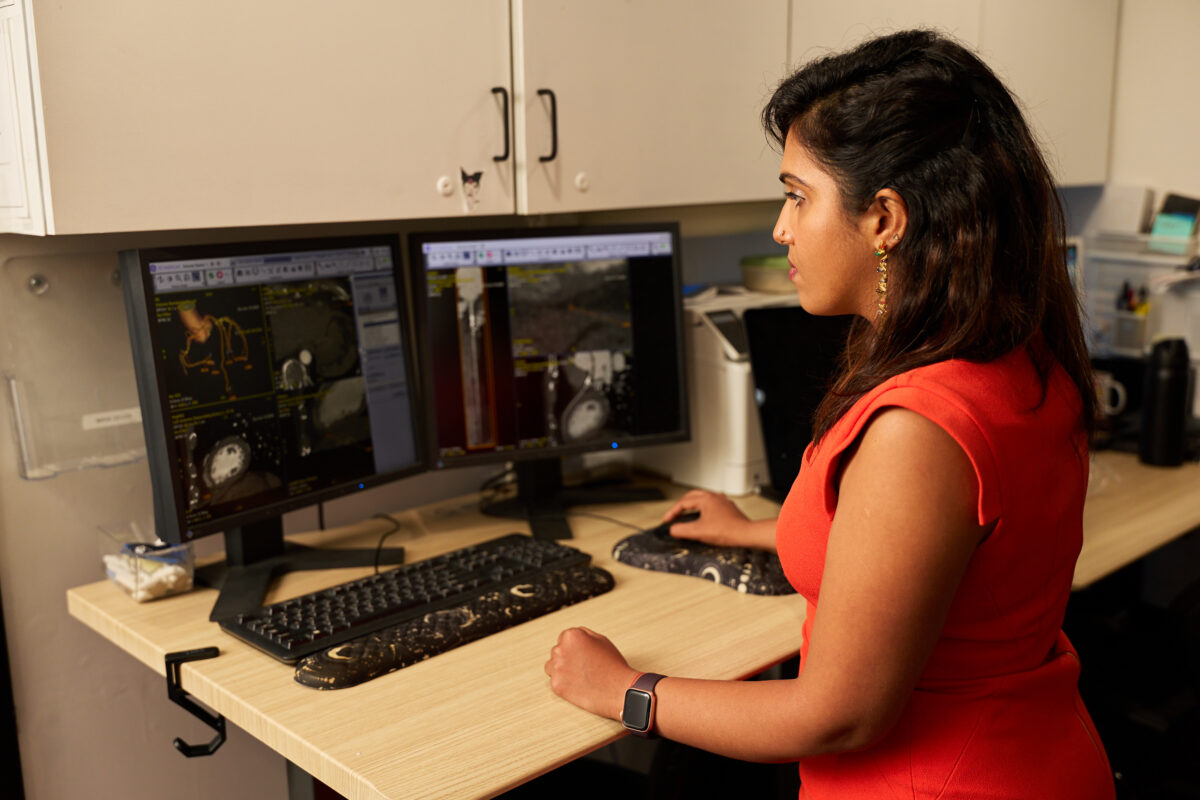
Today, doctors can see plaque without surgery by using a special CT scan of the heart. New artificial intelligence tools can then measure exactly how much plaque is present, much like taking an inventory of what’s lining the artery walls.
Learning From a Landmark Study
Dr. Lakshmanan and her colleagues looked at data from the ISCHEMIA trial, a major international study funded by the National Institutes of Health that followed more than 5,000 people with stable heart disease. For this analysis, the team focused on 3,645 participants who had CT scans showing significant narrowing in their heart arteries.
Researchers measured how much of each person’s artery walls had evidence of plaque and then tracked the participants for about three years to understand their health outcomes.
A Surprising Difference Between Women and Men
The study’s findings revealed a striking pattern:
- Women had less plaque than men. On average, plaque took up about 17 percent of the artery volume in women, compared with about 21 percent in men. Women also had fewer of the plaque features doctors consider high risk.
- Plaque was more dangerous for women. For every 10 percent increase in plaque, a woman’s risk of heart attack or heart-related death rose by about 61 percent. For men, the same increase raised risk by about 31 percent.
- Risk climbed steadily in women. As plaque increased, women’s risk went up step by step. In men, the pattern was less consistent.
These differences held up even after the researchers accounted for age, diabetes, high blood pressure, smoking, kidney function, cholesterol medication and how narrow the arteries were.
Why Might Women Be More Vulnerable?
The study points to one possible explanation: size. Women’s heart arteries tend to be smaller than men’s, so the same amount of plaque may take up more of the available space. Earlier research has also shown that when plaque breaks open in women, it is more likely to cause a blood clot and a serious heart event.
As a cardiologist, I see it often: a patient whose heart disease went unnoticed until it became an emergency. Too often, that patient is a woman. My research is focused on changing this paradigm.
Dr. Lakshmanan
Toward Better Prevention for Women
Heart disease is the leading cause of death for women in the United States, yet women’s symptoms and risks are still too often underestimated. This research suggests that measuring plaque could help doctors identify which women would benefit most from earlier and more intensive prevention, such as cholesterol-lowering medications and lifestyle changes.
The researchers note that more work is needed to confirm these findings, since the study was not originally designed to compare women and men, and most participants were men. Still, the results add to a growing body of evidence that women’s heart health deserves its own careful attention.
Dr. Lakshmanan’s broader research looks at how inflammation, cholesterol, diabetes and kidney health work together to raise heart risk, and how that risk differs between women and men, so care can be tailored to each patient.
Using a detailed CT scan of the heart, we can see plaque building up in the arteries long before it causes a heart attack. Our goal is to protect hearts before a crisis happens.
Dr. Lakshmanan
It is what translation in the clinic looks like at The Lundquist Institute: bringing what we learn through research directly to the people we care for.
The study was a collaboration among researchers at The Lundquist Institute, Stanford University, NYU Grossman School of Medicine, the Icahn School of Medicine at Mount Sinai, the University of British Columbia and other institutions. The Lundquist Institute’s Matthew Budoff, MD, is a co-author.
Read the full study: Lakshmanan S, et al. “Sex-Specific Coronary Plaque Characteristics and Risk of Cardiovascular Events: Insights from ISCHEMIA.” American Heart Journal, 2026. https://doi.org/10.1016/j.ahj.2026.107633.