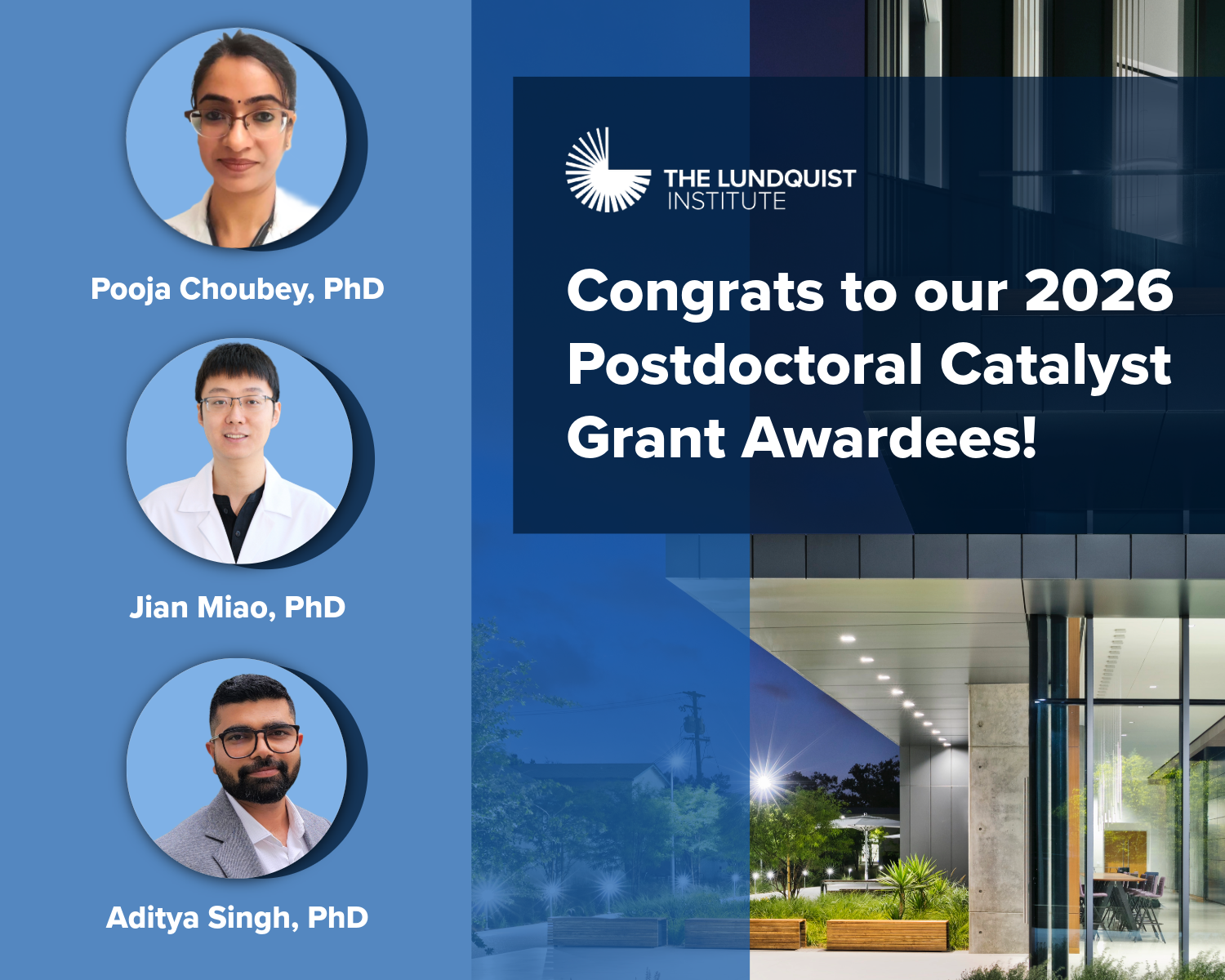
Seed funding from The Lundquist Institute Research Committee, made possible by the generosity of the Kenneth T. and Eileen L. Norris Foundation, helps postdoctoral researchers take their first big step toward leading their own labs.
Every major medical breakthrough starts with a question, and often that question belongs to an early-career scientist who needs a chance to test it. This year, three of The Lundquist Institute’s promising postdoctoral researchers are getting that chance.
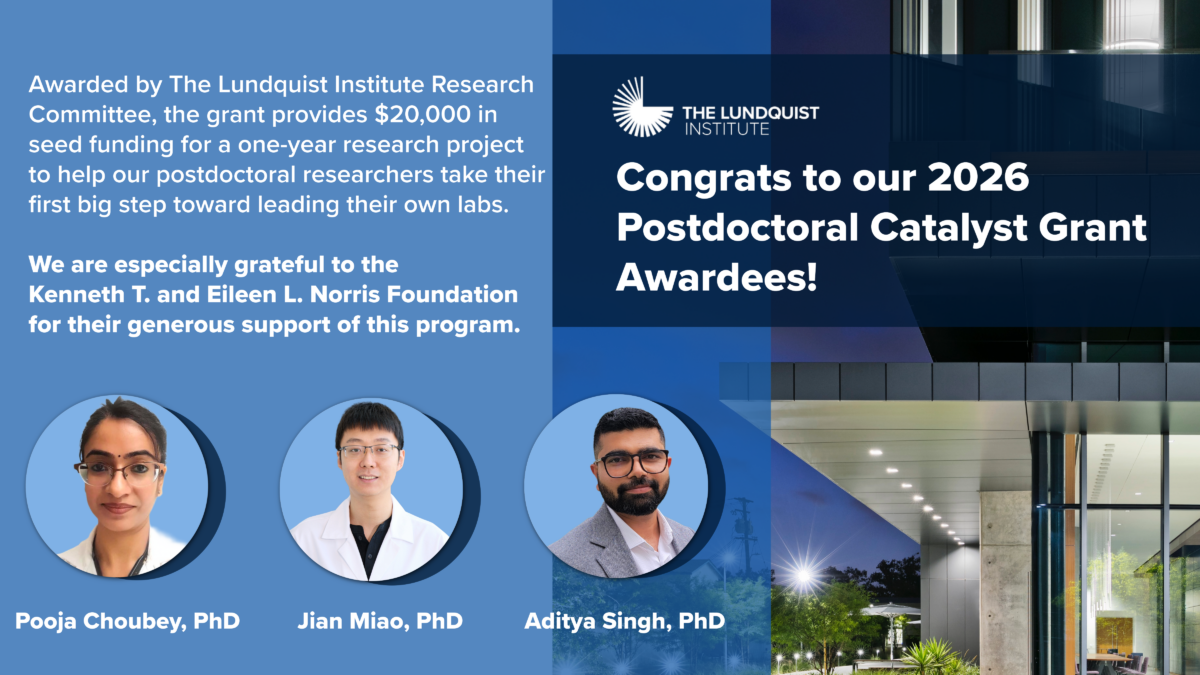
Dr. Pooja Choubey, Dr. Jian Miao, and Dr. Aditya Singh have each received a 2026 Postdoctoral Catalyst Grant from The Lundquist Institute Research Committee. Each grant provides $20,000 in seed funding for a one-year research project. Together, their projects tackle one of the fastest-growing liver diseases in the world, a dangerous infection in newborns, and a rare childhood disease.
Investing in the Next Generation of Scientists
Postdoctoral researchers, often called postdocs, are scientists who have earned their doctoral degree and are completing advanced training before launching independent careers. It is a pivotal and often precarious stage. To compete for major grants from agencies like the National Institutes of Health, early-career scientists need initial results that show their ideas can work. But getting those first results takes funding that can be hard to come by.
The Catalyst Grant program was created to close that gap. It gives postdocs within seven years of their degree the resources to explore their own original ideas and to gather the early data they need to win larger fellowships and grants. Applications are reviewed by investigators from The Lundquist Institute who use the same scoring approach as the National Institutes of Health, so earning the grant is both a vote of confidence and real-world practice for the competitive grant process ahead.
Each recipient works alongside an experienced investigator who serves as a mentor, and at the end of the year, they will share what they discover with colleagues across campus.
Made Possible by the Norris Foundation
The Postdoctoral Catalyst Grant program is supported by the generosity of the Kenneth T. and Eileen L. Norris Foundation. Their commitment means that talented early-career scientists at The Lundquist Institute can pursue bold ideas at the very moment when support matters most.
“Gifts like this have an outsized impact. A modest investment in a postdoc’s idea today can grow into a multimillion-dollar research program, new treatments, and a scientific career that benefits patients for decades,” said Joe W. Ramos, Ph.D., President and CEO of The Lundquist Institute. “We are deeply grateful to the Norris Foundation for helping our postdoctoral researchers take their first step toward independent careers.”
Meet the 2026 Catalyst Grant Recipients
Dr. Pooja Choubey: Uncovering Early Drivers of Fatty Liver Disease
Mentor: Michelle Matter, PhD
Fatty liver disease affects roughly one in three adults worldwide and is becoming increasingly common in children. In its most severe form, known as MASH (metabolic dysfunction-associated steatohepatitis), fat buildup in the liver leads to inflammation and damage that can progress to scarring, liver failure, or liver cancer.
Dr. Choubey’s research focuses on PTRH2, a protein that helps cells respond to stress. Using a unique mouse model that develops early liver disease, her project will examine how the loss of PTRH2 pushes liver cells into a state called senescence, in which they stop functioning normally and contribute to inflammation. By understanding how this stress and early senescence drive liver injury, the work aims to find new ways to detect MASH early, when treatment can make the biggest difference.
Dr. Jian Miao: Protecting Newborns from a Dangerous Fungal Infection
Mentor: Marc Swidergall, PhD
Candida albicans is a common fungus that usually lives harmlessly in and on our bodies. But in newborns, especially babies born prematurely, it can invade the bloodstream and spread to vital organs. This condition, called neonatal invasive candidiasis, is one of the most life-threatening infections facing infants in neonatal intensive care units.
Newborns don’t fight infections the same way adults do. Dr. Miao is building a new mouse model to understand how a newborn’s body fights back against this fungal infection, and why some organs are hit harder than others. By learning how the immune response differs from organ to organ, his work could help doctors protect the most vulnerable babies and guide better treatments in the future.
Dr. Aditya Singh: Could Healing the Brain’s Blood Vessels Protect From a Rare Childhood Disease?
Mentor: Paul Mathews, PhD
Ataxia telangiectasia, often called A-T, is a rare inherited disease that typically appears in early childhood. Children with A-T gradually lose control of their movement and balance. The disease particularly affects the cerebellum, a small region at the back of the brain that contains more neurons than all other brain regions combined. Many patients also face a weakened immune system and a higher risk of cancer, and most live only into early adulthood. There is currently no cure.
Dr. Singh is testing a new idea. A sugar-cube-sized piece of the brain contains about a mile of tiny blood vessels, and because those vessels are affected in A-T, the brain damage may begin with problems in its blood supply. He is studying the neurovascular unit (NVU), the close partnership between brain cells and the tiny blood vessels that feed them. When that partnership breaks down, the brain can’t get the nourishment and support it needs. After measuring how much damage the NVU has in A-T, his project will test whether non-invasive sensory stimulation can help restore its healthy function. If successful, the work could point toward a gentle therapy, used alone or alongside medication, that could complement new drug and gene-based treatments for a disease with very few options. It could also shed new light on how the cerebellum works, in health and disease.
Where Careers and Discoveries Begin
The Lundquist Institute has been training scientists and advancing medical discovery for nearly 75 years. The Postdoctoral Catalyst Grant program reflects a simple belief: the future of medicine depends on the people we support today. By pairing promising postdocs with dedicated mentors and the generous backing of partners like the Norris Foundation, The Lundquist Institute is helping the next generation of scientists turn bold questions into discoveries that improve lives.
Congratulations to Dr. Choubey, Dr. Miao, and Dr. Singh. We look forward to sharing what they discover.
To learn how you can support early-career scientists at The Lundquist Institute, visit give.lundquist.org/donate.