
Soula Danopoulos, PhD, an investigator in the Advanced Therapeutics and Biomedical Technologies Innovation Hub at The Lundquist Institute, has published the research manuscript, “Excess type I interferon disrupts developmental crosstalk and promotes premature distalization in trisomy 21 lungs,” in Nature Communications, one of the leading international journals for multidisciplinary scientific research. The publication addresses an important area of biomedical research. Individuals with trisomy 21, also known as Down syndrome, can experience a range of respiratory complications, making a deeper understanding of the developmental and molecular factors contributing to congenital lung anomalies particularly valuable. This work, supported by an NIH grant to Dr. Danopoulos, involved collaborators at The Lundquist Institute (Dr. Denise Al Alam), the University of Rochester and Seattle Children’s Hospital, with primary experimental contributions led by an outstanding postdoctoral fellow, Dr. Randa Belgacemi.
Dr. Danopoulos’ research program aims to advance our understanding of lung development and the biological mechanisms underlying respiratory anomalies associated with trisomy 21. The accepted study investigates the role of type I interferon, a family of immune-signaling proteins that help regulate the body’s response to infection and influence a range of cellular processes. While these proteins are essential for immune defense, excessive interferon signaling can disrupt normal biological functions. Dr. Danopoulos and her lab explored how elevated type I interferon activity affects the coordinated interactions between developing lung cells, potentially altering the normal progression of lung development in trisomy 21.
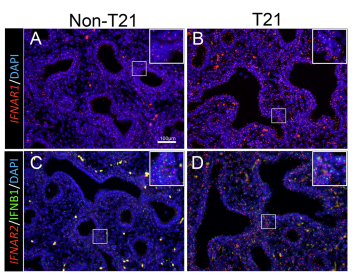
Image (cropped from original): Belgacemi R, Danopoulos S, et al., Nature Communications (2026), licensed under CC BY 4.0.
A central focus of the work described in the publication is the disruption of developmental crosstalk, the communication between different cell populations that enables tissues to develop in an organized and coordinated manner. Such interactions are fundamental to the formation of the complex structures required for healthy lung function. A clearer understanding of these pathways could ultimately support the identification of new research directions and potential therapeutic targets for respiratory conditions associated with trisomy 21.
This achievement marks an important step in Dr. Danopoulos’ contribution to the field and highlights the value of research that bridges developmental biology and immunology to address complex health challenges. It is ultimately poised to contribute to ongoing international scientific discussions about lung development, immune signaling and the biological consequences of trisomy 21.